
LED grow lighting: spectrum, PPFD and photoperiod
Light is food for a plant. Learn what spectrum, PPFD, DLI and photoperiod really mean, and exactly how much light your lettuce, herbs and fruiting crops need to thrive.
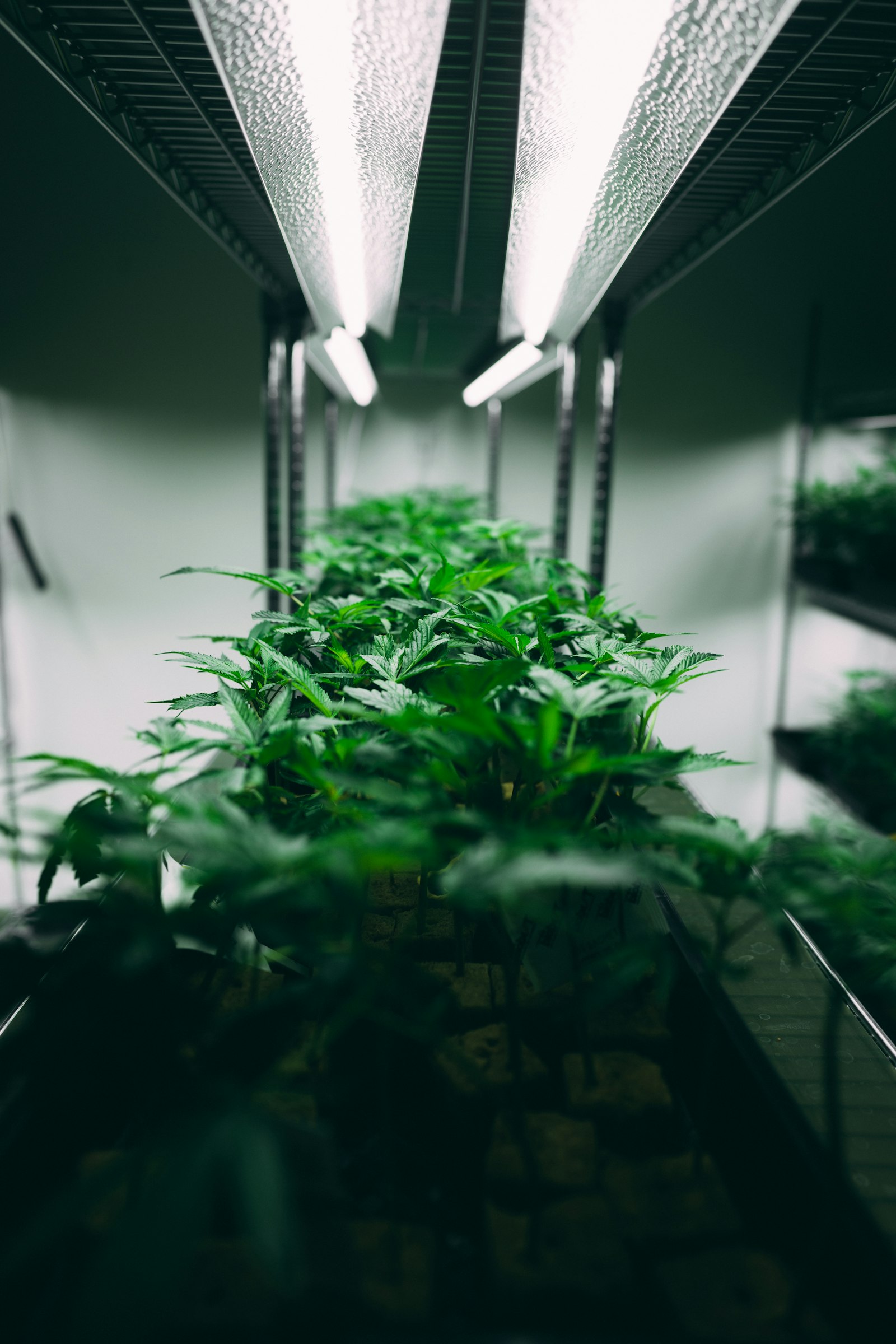
Light is food, not decoration
When a plant grows in your apartment, it is literally eating light. Through photosynthesis it turns photons into sugars, and from those sugars it builds leaves, roots and fruit. That makes lighting the single most important factor in indoor growing - even more important than a perfect nutrient solution. You can have flawless EC and pH, but if a plant is starved of light it will stay pale, stretched and unhappy.
The good news: modern grow LEDs are cheap to run, cool to the touch and remarkably efficient. The bad news: the market is full of marketing numbers that mean nothing ("10,000 W equivalent!"). In this guide we translate the three terms that actually decide your harvest, and that you will see on every serious spec sheet: spectrum, PPFD and photoperiod.
Spectrum: the colour of light and what it does
Plants do not use light the way our eyes do. The blue and red parts of the spectrum matter most to them, which is why cheap panels often glow with that recognisable purple "blurple" light - a mix of blue and red diodes with no white.
- Blue light (~450 nm) drives compact, sturdy growth: short internodes, thick stems and lush green leaves. Without enough blue, a plant stretches in search of light.
- Red light (~660 nm) is the main engine of photosynthesis and biomass. It promotes flowering and fruit development, so it is crucial for tomatoes, peppers and strawberries.
- Far-red (~730 nm) influences germination, stem elongation and shade response. In small doses it can speed growth, but you do not want too much of it.
- Green light is used less by the plant, but it penetrates deeper into the canopy and makes the light far more pleasant for the human eye.
For home growing the recommendation is simple: choose a full-spectrum (white) LED. It is sunlight-like, easy on the eyes, great for photos of your garden, and perfectly capable of carrying a plant from seedling to harvest. A warmer colour temperature around 3000-4000 K delivers more red (good for fruit), while 5000-6500 K delivers more blue (compact lettuces and transplants). For a mixed home garden, a happy medium around 4000 K works beautifully.
PPFD: how much light actually reaches the plant
This is the term that separates serious growing from guesswork. PPFD (Photosynthetic Photon Flux Density) measures how many useful photons (those in the 400-700 nm range) land on a square metre every second, expressed in µmol/m²/s. In plain terms: PPFD is the light intensity at leaf height.
It is important to understand that PPFD falls off with the square of distance. The same lamp at 20 cm from a plant delivers many times the PPFD it does at 50 cm. That is why two identical lamps can give completely different results depending on how they are mounted.
Reference values:
- Leafy greens and herbs thrive at 150-250 µmol/m²/s. Above that, lettuce simply cannot grow any faster and you are burning electricity for nothing.
- Fruiting crops (tomato, pepper, strawberry) need 400-600 µmol/m²/s to set and ripen fruit.
- Seedlings and transplants are happy with 100-150 µmol/m²/s - too much light stresses tender seedlings.
Do not assume "more is always better". Beyond a certain point (the light saturation point) the plant cannot use the extra photons, and overly intense light can bleach leaves and cause stress.
Photoperiod and DLI: how many hours, and how much in total
Photoperiod is the number of hours of light per day. DLI (Daily Light Integral) is the total amount of light a plant receives over a day - the product of PPFD and duration, expressed in mol/m²/day. DLI is arguably the most important number because it combines intensity and duration into a single "daily light dose".
Two lamps can deliver the same DLI: a weaker one on for longer, or a stronger one on for less time. For home growing that is liberating - a modest LED running 14-16 hours often matches a stronger lamp running fewer hours.
Reference DLI targets:
- Leafy greens: 12-17 mol/m²/day
- Herbs: 12-18 mol/m²/day
- Fruiting crops: 20-30 mol/m²/day
How do you convert? The formula is: DLI = PPFD × hours × 0.0036. Example: lettuce at 200 µmol/m²/s for 16 hours a day = 200 × 16 × 0.0036 = 11.5 mol/m²/day. That sits near the lower limit for lettuce - bump the photoperiod to 18 hours or move the lamp slightly closer.
The importance of darkness: plants need night too. Leafy greens and herbs are perfectly content with 14-16 hours of light and 8-10 hours of dark. Some fruiting crops (tomato) tolerate up to 18 hours. The simplest fix is a cheap plug-in timer - set it once and forget it.
Table: light by crop
| Crop type | PPFD (µmol/m²/s) | Photoperiod | Target DLI (mol/m²/day) |
|---|---|---|---|
| Seedlings & transplants | 100-150 | 16-18 h | 8-12 |
| Lettuce & leafy greens | 150-250 | 14-16 h | 12-17 |
| Herbs (basil, parsley) | 200-300 | 14-16 h | 12-18 |
| Strawberries | 300-450 | 14-16 h | 17-22 |
| Tomato, pepper, cucumber | 400-600 | 16-18 h | 20-30 |
Practical tips for the home garden
- Keep the lamp close, but not too strong. For leafy greens, 25-40 cm above the canopy usually delivers the target 150-250 µmol/m²/s. Lower it if plants stretch, raise it if leaves bleach.
- Read the plant, not just the numbers. Stretched, pale stems = too little light. Bleached or curled leaf edges = too much. Compact, dark growth = you nailed it.
- Do not buy by watts. Wattage tells you how much electricity a lamp draws, not how much light it gives the plant. Look for stated PPFD or PPF (µmol/s) and efficiency (µmol/J).
- Blend warm and cool white. If you build your own lighting, combining 3000 K and 5000 K diodes gives a balanced, full-spectrum result.
If you would rather skip the maths, dojdi vertical towers with built-in LED lighting ship with spectrum and intensity already tuned for leafy greens and herbs - set the timer and your plants get exactly the light they need, no meter and no guessing.
Key takeaways
- Spectrum shapes growth: blue for compactness, red for fruit. For home use, choose a full-spectrum white LED (~4000 K).
- PPFD is light intensity at the leaf: 150-250 µmol/m²/s for leafy, 400-600 for fruiting. It falls off with distance.
- Photoperiod is duration (14-16 h for leafy), and DLI combines intensity and duration into a daily dose - aim for 12-17 mol/m²/day for lettuce.
- More light is not always better; beyond the saturation point you are just wasting electricity.
- Buy a lamp by PPFD/PPF and efficiency (µmol/J), not by watts.
Related articles: Growing without natural light | Temperature, humidity and airflow | Beginner's guide | Growing lettuce
Related articles
 💡 Light & environment
Growing without natural light (basements and apartments)
No sunlight? No problem. A practical guide to growing lettuce and herbs in a basement, pantry or north-facing flat - from choosing a lamp to managing humidity, air and heat.
 💡 Light & environment
Temperature, humidity and airflow
Light and nutrients are only half the story; the climate around the plant is the other half. Learn the ideal ranges for temperature, humidity and airflow, plus the basics of VPD.