
How to mix and dose liquid nutrients
Step by step to a perfect solution: mixing order, the A-then-B rule, a per-crop dosing table, and the most common mistakes to avoid.
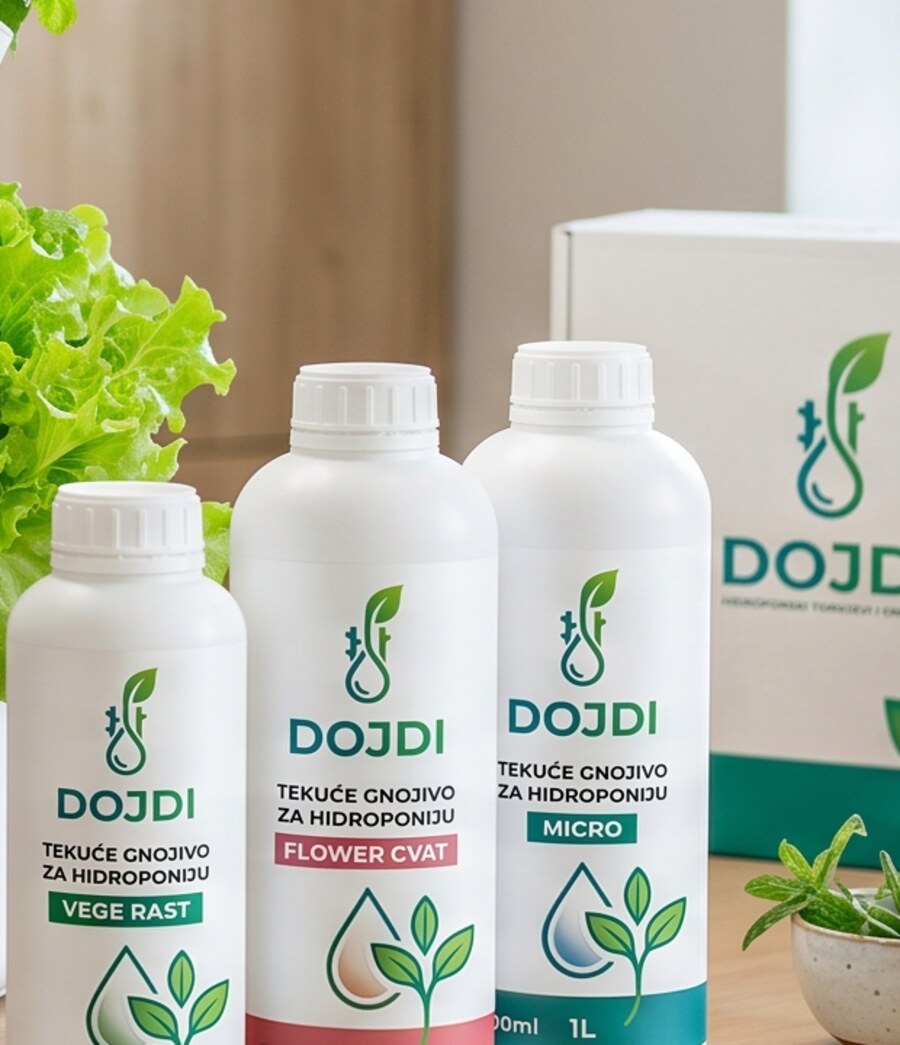
From bottle to reservoir, without guesswork
Mixing fertiliser sounds intimidating until you realise it's just cooking from a recipe: add concentrate to water, stir, measure and adjust. The whole skill comes down to order, units and a few safety rules. Once you've got those, mixing a solution takes five minutes.
This guide walks you through it step by step — from an empty container to a tower-ready solution — and gives you a dosing table you can stick next to the reservoir.
What you need
- Liquid fertiliser (e.g. the dojdi mix for your crop; often a two-part A + B set).
- Clean base water (see Water quality).
- An EC/TDS meter and a pH meter (calibrated).
- pH Down and pH Up.
- A clean container, a syringe or measuring cup (mL), gloves.
The golden rule: A then B, never together
Many quality fertilisers come in two bottles (A and B). The reason is chemical: bottle A usually carries calcium, while bottle B carries sulphates and phosphates. If you mix them in concentrated form — with no water in between — the calcium binds with the sulphates and forms a white precipitate (calcium sulphate) the plant can't use. Your expensive fertiliser sinks to the bottom as gypsum.
So the rule is:
- Water goes into the reservoir first.
- Add bottle A, stir well.
- Only then add bottle B, and stir again.
- Never combine concentrated A and B directly into each other.
If your dojdi fertiliser comes as a single bottle, the formulation is already balanced and you simply follow the recommended dose.
Step by step
1. Measure the base water
Fill the reservoir and record the starting EC and pH. Say, EC 0.3 and pH 7.2.
2. Work out how much fertiliser you need
Target EC for lettuce is, say, 1.0 mS/cm. Your water already carries 0.3, so the fertiliser needs to add about 0.7 mS/cm. Start from the label's recommended dose but aim a little low and top up as needed.
3. Add fertiliser gradually
Add roughly 70–80% of the estimated dose, stir for 30 seconds, then measure EC. It's easier to add more than to dilute a whole reservoir.
4. Only now adjust the pH
The fertiliser has already shifted the pH. Now add pH Down (or Up) a few drops at a time, stir, wait a minute, measure. Target: 5.5–6.5 (for lettuce and herbs, 5.8–6.2 is ideal).
5. Record the recipe
Note how many mL of fertiliser and how many drops of pH Down you used for your X litres. Next time it'll take thirty seconds.
Dosing table (a starting guide)
These are approximate values for a balanced complete fertiliser and base water around EC 0.3. The instructions on your fertiliser's label always take priority.
| Crop | Target EC (mS/cm) | Target pH | Rough dose* |
|---|---|---|---|
| Seedlings / transplants | 0.4 – 0.8 | 5.8 – 6.2 | ~0.5 mL/L |
| Lettuce, lamb's lettuce, rocket | 0.8 – 1.2 | 5.8 – 6.2 | ~1.0–1.5 mL/L |
| Herbs | 1.0 – 1.6 | 5.8 – 6.3 | ~1.5–2.0 mL/L |
| Chard, kale, spinach | 1.4 – 1.8 | 5.8 – 6.3 | ~2.0–2.5 mL/L |
| Strawberries & berries | 1.4 – 2.0 | 5.5 – 6.0 | ~2.0–2.5 mL/L |
| Tomato, pepper, cucumber | 2.0 – 2.8 | 5.8 – 6.3 | ~2.5–3.5 mL/L |
* "mL/L" means millilitres of fertiliser per litre of water. The dose depends on your fertiliser's concentration — always check the label and adjust by measured EC, not by eye.
Tip for working out volume: if you don't know how many litres the tower holds, fill it from empty using a measured container (e.g. a 1.5 L bottle) and add it up. An accurate volume makes dosing precise.
A worked example
Say you have a 20 L tower and you're growing lettuce (target EC around 1.0 mS/cm). Your water has a starting EC of 0.3, and the label recommends 1.5 mL/L.
- Estimated dose: 20 L × 1.5 mL/L = 30 mL of fertiliser.
- Add about 80% of that (≈ 24 mL), stir, measure EC.
- If it reads 0.85 mS/cm, add a little more (a couple of mL), measure again — and so on until you reach ~1.0.
- Write down the total mL you used. That's your personal recipe for next time.
Five minutes of arithmetic like this, once, frees you from guesswork forever.
Topping up and changing the solution
Plants drink water faster than nutrients, so over time the EC in the reservoir rises while the level drops.
- Top-up: when the level falls, top up with plain water (not a full dose of fertiliser), because the nutrients are still there, just more concentrated. Measure EC and only add a little fertiliser if needed.
- Full change: every 1–2 weeks drain the old solution and make a fresh one. This prevents the element ratio from drifting (the plant uses some elements faster than others) and salts from building up.
- In summer and under strong LED light the solution is consumed faster — check more often.
The most common mistakes
- Overdosing. "More = better" doesn't hold; excess EC scorches leaf edges. Start low.
- Combining A and B as concentrates. See above — always water in between.
- Adjusting pH before fertiliser. Pointless, since the fertiliser shifts pH again.
- Uncalibrated meters. Without calibration every number is random. Calibrate the pH meter with 4.0 and 7.0 buffers.
- Forgetting to change the solution. Old solution = a skewed ratio and possible deficiency (see Nutrient deficiency symptoms).
Safety
Fertilisers are concentrated salts and acids. Wear gloves, don't mix concentrates directly, keep them away from children, and never decant into drink bottles. pH Up/Down are strong substances — add them to water, never water to them.
Key takeaways
- Order: water → fertiliser (A then B) → measure EC → adjust pH.
- Never combine concentrated A and B directly — it forms an unusable precipitate.
- Aim for the EC and pH in the table, but the label of your fertiliser and the measured EC take priority over eyeballing.
- Top up with plain water, and change the whole solution every 1–2 weeks.
- Calibrate your meters, start with a lower dose and record your recipe — balanced dojdi fertilisers do the rest of the work for you.
Related articles
 💧 Nutrients & water
Understanding EC and pH
EC and pH are the two numbers that decide your hydroponic success. Learn what they mean, which values to target per crop, and how to adjust them easily in a home tower.
💧 Nutrients & water
Nutrient solution: macro- and micro-elements explained
Which elements does a plant need and what does each one do? A guide through the macro- and micronutrients of a hydroponic solution, with the mobile/immobile rule that speeds up diagnosis.
 💧 Nutrients & water
Water quality in hydroponics (chlorine, hardness, RO water)
Water sets the foundation of every hydroponic solution. Learn how chlorine, chloramine, hardness and RO water affect your tower, and how to prepare ideal base water in a few steps.